
“On the sacred occasion of Magh Purnima and the birth anniversary of Guru Ravidas, I present the Budget for the year 2026–27.”
— Nirmala Sitharaman
The Union Budget for FY 2026–27 was presented in Parliament on Sunday, 1 February 2026, by Finance Minister Nirmala Sitharaman, marking her ninth consecutive budget presentation—a historic milestone in itself.
Beyond the numbers, the Union Budget is a document that directly shapes the everyday lives of citizens. As common Indians, our expectations from the Budget are simple yet crucial: policies that make life more affordable, livelihoods more secure, and opportunities more accessible. With these expectations in mind, let us examine what this year’s Budget offers.
A Budget Rooted in History, Tradition, and Symbolism
For the first time in independent India’s history, the Union Budget was presented on a Sunday—a day traditionally observed as a holiday by government and private institutions alike.
Continuing a tradition she began in 2019, the Finance Minister carried the Budget documents in a red ‘Bahi-Khata’ style pouch, replacing the colonial-era briefcase. Before heading to Parliament, she met the President of India, Droupadi Murmu, who offered dahi-chini (curd and sugar), a customary symbol of good fortune.
Key Themes of the Union Budget 2026–27
The government reiterated its commitment to:
- Employment generation
- Strengthening agriculture
- Enhancing household purchasing power
- Delivering universal public services
Despite ongoing global economic and geopolitical uncertainties, the government maintained that India remains on a steady growth trajectory, with a focus on inclusive and sustainable development.
Sector-Wise Highlights
Manufacturing & Industrial Growth
- Biopharma SHAKTI: ₹10,000 crore over five years to establish three new bio-pharmaceutical institutes and upgrade seven existing ones
- India Semiconductor Mission (ISM) 2.0: ₹40,000 crore allocation; ₹22,919 crore already invested
- Rare Earth Corridors in Odisha, Kerala, Andhra Pradesh, and Tamil Nadu
- ₹10,000 crore for container manufacturing over five years
- Revival of 200 legacy industrial clusters
Textile & Labour-Intensive Industries
- National Fibre Scheme (natural, man-made, and next-generation fibres)
- Textile Expansion and Employment Scheme
- National Handloom and Handicraft Programme
- Samarth 2.0 for textile skilling modernisation
- Mega Textile Parks
- Mahatma Gandhi Gram Swaraj Initiative to strengthen khadi, handloom, and handicrafts through global branding
MSMEs: Making Small Businesses Champions
- ₹10,000 crore SME Growth Fund for equity support
- ₹2,000 crore top-up to Self-Reliant India Fund (2021)
- Liquidity support measures to ease credit flow
Infrastructure & Connectivity
- Focus on Tier-2 and Tier-3 cities (population above 5 lakh)
- Port connectivity enhancement
- Ship repair ecosystem at Varanasi and Patna
- Seaplane services
- City Economic Regions (CERs): ₹5,000 crore per region for five years
- Development of seven high-speed rail corridors for sustainable transport
Finance & Markets
- High-level committee on banking reforms for Viksit Bharat
- Review of FEMA non-debt instruments rules
- Strengthening corporate bond markets
- Municipal bond reforms with ₹100 crore support for large issuances
- Permission for PIOs to invest in listed Indian companies
Technology & Innovation
- Support through AI Mission, National Quantum Mission,
National Research Fund, and R&D and Innovation Fund
Health, Youth & Care Economy
- Appointment of 1 lakh Allied Health Professionals over five years
- Training of 1.5 lakh caregivers
- Hubs for Medical Value Tourism
- Establishment of three All India Institutes of Ayurveda
- Upgrade of WHO Global Traditional Medicine Centre, Jamnagar
- Support for private veterinary and para-veterinary infrastructure
Orange Economy (AVGC Sector)
- AVGC creator labs in 15,000 schools and 5,000 colleges
- Support to Indian Institute of Creative Technologies, Mumbai
- New National Institute of Design in eastern India
Education & Tourism
- Five university townships along industrial corridors
- One girls’ hostel in every district
- Focus on astrophysics research
- National Institute of Hospitality
- Upskilling 10,000 tourist guides at 20 iconic sites
- Promotion of trekking and cultural tourism, especially in mountain states
Agriculture, Social Welfare & Mental Health
- Focus on high-value crops (coconut, cashew, sandalwood, walnuts)
- Bharat Vistar: multilingual AI tool for farmers
- SHE (Self-Help Entrepreneur) Marts as community-owned outlets
- Divyangjan Kaushal Yojana
- Establishment of NIMHANS-2 and upgrades in Ranchi and Tezpur
- Special focus on Purvodaya and Northeast India
Taxation Highlights
Direct Taxes
- New Income Tax Act 2025 effective from 1 April 2026
- Tax exemption on motor accident compensation interest
- Reduction in TCS on overseas tours, education, and medical expenses from 5% to 2%
- Lower TDS on manpower services (1–2%)
IT & Corporate Taxation
- Fixed safe harbour margin of 15.5% for IT services
- Tax holiday for foreign cloud service providers operating data centres in India
- Share buybacks taxed as capital gains (22% for corporate promoters, 30% for non-corporates)
Indirect Taxes
- 2% TCS on alcohol, scrap, and minerals, likely impacting prices
Fiscal Position
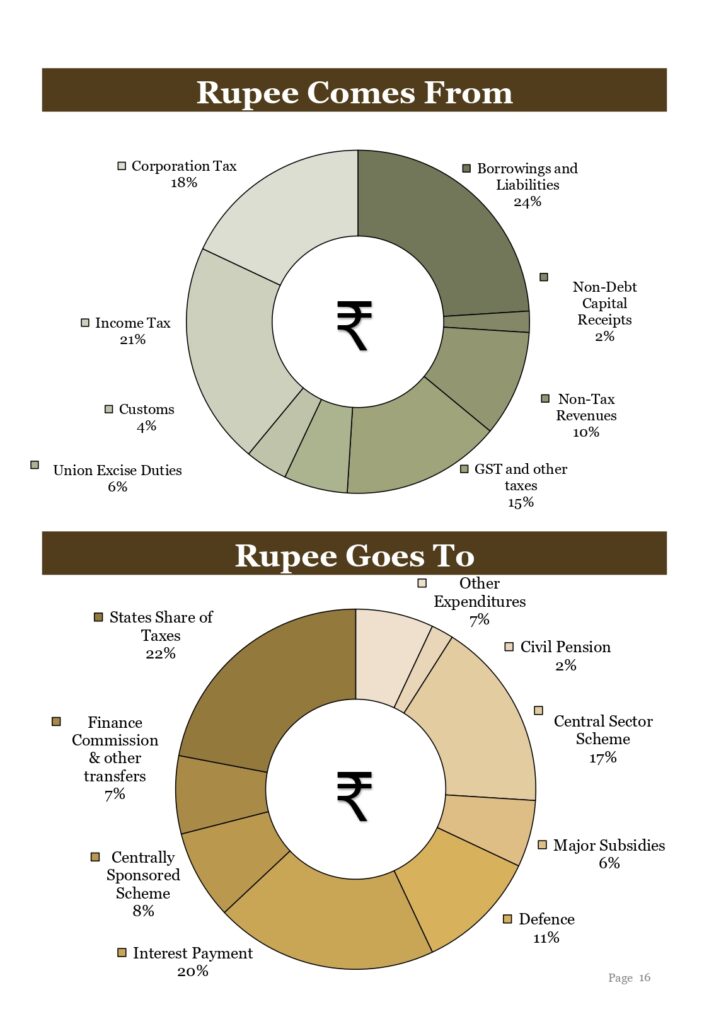
The government will borrow ₹17.2 trillion in FY 2026–27—slightly lower than the previous year—aiming for long-term fiscal stability while sustaining growth.
Budget 2026 Impact: What Got Cheaper vs What Got Costlier
| Cheaper for Consumers | Why |
|---|---|
| Life-saving medicines (cancer, diabetes, rare diseases) | Reduction/exemption in customs duty |
| Overseas tour packages | TCS reduced from 5% to 2% |
| Foreign education expenses | Lower TCS under LRS |
| Medical treatment abroad | Reduced TCS burden |
| EV, solar & green-energy components | Customs duty cuts to promote clean energy |
| Select electronics & manufacturing inputs | Duty exemptions to boost domestic production |
| Costlier for Consumers | Why |
|---|---|
| Alcohol | Higher taxes and increased TCS |
| Tobacco products (cigarettes, gutka, etc.) | Increased sin tax |
| Commercial LPG cylinders (19 kg) | Price hike impacting businesses |
| Eating out & food services | Indirect impact due to higher LPG costs |
| Imported coffee machines & vending equipment | Withdrawal of duty exemptions |
| High-end imported electronics | Higher effective customs duties |
| Futures & Options (F&O) trading | Increased transaction taxes |
| Alcohol, scrap & minerals (indirectly) | TCS raised to 2% |
Final take away
The Union Budget 2026–27 underscores the government’s push towards infrastructure-led growth, technology-driven development, healthcare expansion, employment generation, and sustainable tourism. While ambitious in scope, its real impact will depend on implementation, accountability, and how effectively these measures reach the ground.
For ordinary citizens, the Budget offers hope—but the true test lies ahead.
Share this on

